


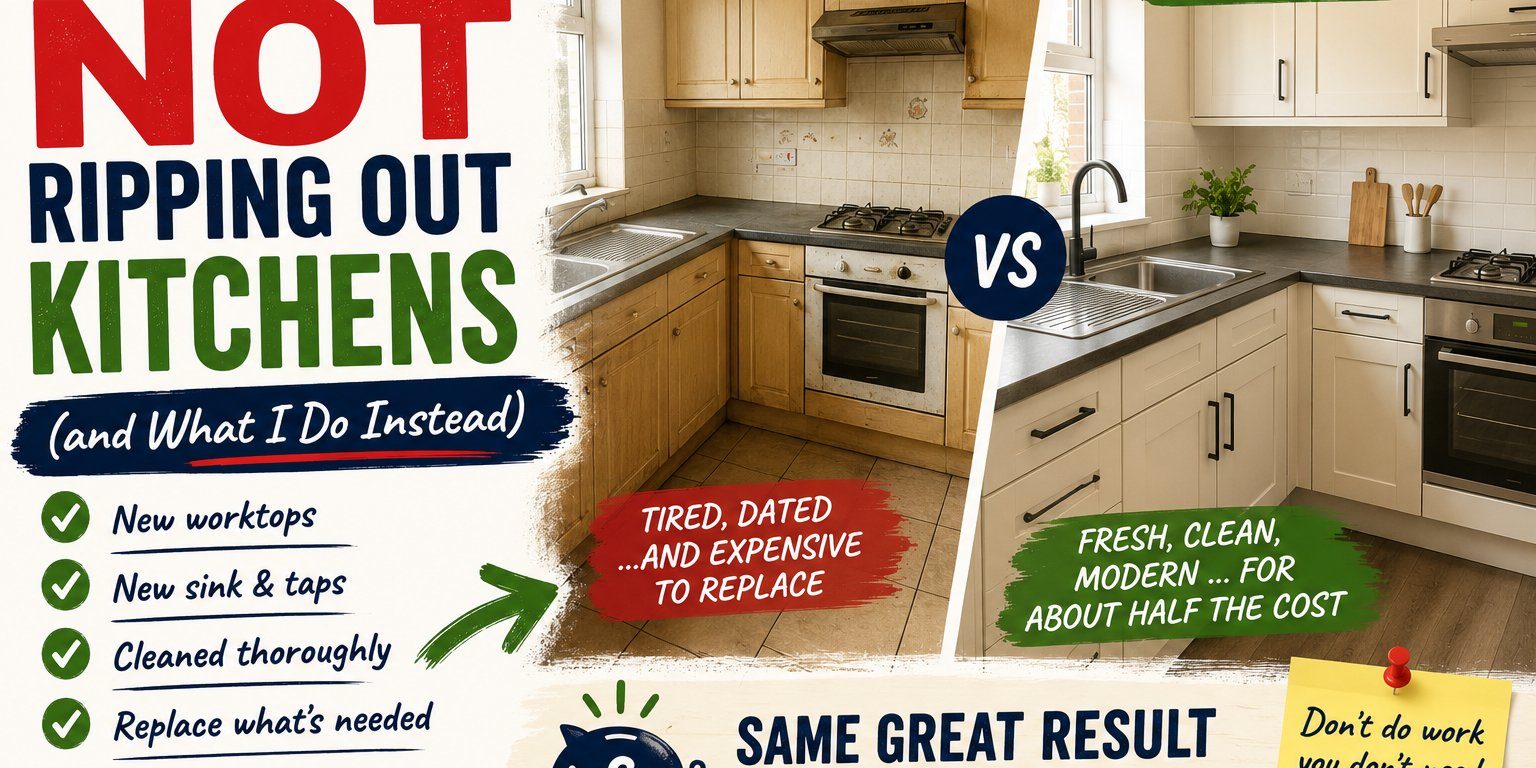
For years, whenever I took on a new rental property, I ripped the kitchen out. Usually for perfectly good reason – the kitchens in older terraced houses, ex-rentals and probate sales tend to be old, cheap and not particularly nice, and twenty years of tenants living in them hadn’t generally improved things. So out they came, without much deliberation.
I still think that was often the right call. But I’ve learned, sometimes expensively, that it isn’t always the right call – and knowing the difference has saved me a significant amount of money.
When You Do Need a New Kitchen
If the carcasses are buckled or bowed, the doors are falling off or the layout simply doesn’t work, replace it. There’s no point rescuing something that’s beyond rescuing. My builder’s go-to is the second-from-bottom range at Wickes – not the cheapest, because that range offers more variety in cabinet sizes, which matters when you’re trying to fill a small space efficiently. But it doesn’t have to be Wickes. B&Q, Howdens, IKEA and other builders’ merchants are all worth a look, and keep an eye out for end-of-range deals – stores discount outgoing ranges heavily when new ones come in. I bought a quality electric hob from John Lewis on sale about two years ago for around £200, half the normal price. That kind of thing is out there if you’re paying attention.
On fitting: off-the-shelf units, my builder on a day rate. No in-store design service, no specialist kitchen company, no kitchen designer. In a small kitchen with eight or ten units, you don’t need any of that.
The Epiphany
After owning some of my properties for fifteen to twenty years, I’d find when tenants left that the place needed a full-ish refurb – hardly surprising given the wear and tear – and I’d automatically start planning a new kitchen. Then one day I stopped and actually looked at what was in front of me.
The worktops were scratched and stained. One or two doors had hinges on their last legs. The stainless steel sink looked old and battered. But the carcasses? Perfectly solid. Nothing buckled, nothing broken.
So I said to my builder: new worktops, new sink and taps, thorough clean throughout, and replace any doors that genuinely need it. Everything else stays.
The result looked fresh, clean and modern. The cost was roughly half what a full replacement would have been.
What the Refresh Actually Involves
Worktops age most visibly – scratches, stains, burn marks. Replacing them alone, without touching the carcasses, transforms how a kitchen looks, and the materials don’t have to cost much. The sink is usually the other obvious culprit: a new sink and taps costs very little and makes a disproportionate difference. Doors are worth looking at individually – replace only the ones that need it, or if they’re all past it, replacement doors for standard carcasses are cheap and easy to source from any decent builders’ merchant. And then a thorough clean of everything – inside the units, outside, the walls behind. It’s remarkable what that does on its own.
I’d do all of this the same way I’d do a full replacement: materials from a builders’ merchant, builder on a day rate. Not one of those specialist “kitchen refresh” firms – they’re solving the right problem but charging more than you need to pay. It’s not complicated.
The Same Principle Again
This is the same thread running through the last two posts: don’t do work you don’t need to do. The question isn’t “should I replace the kitchen?” – it’s “what does this kitchen actually need?” If the carcasses are gone, replace everything. If they’re fine, fix what isn’t and leave the rest. A properly refreshed kitchen can look and function as good as new at half the cost, and the money you’ve saved stays in your margin where it belongs.
Here’s to successful property renovating.

Peter Jones (ex) Chartered Surveyor, author and property investor
www.thepropertyteacher.co.uk
 By the way, I’ve completely rewritten and updated my course for 2026, The Successful Property Renovator’s Workshop – a comprehensive guide to renovating properties properly and profitably, based on my own experience across well over 150 projects over thirty years.
For more details please go to: https://thepropertyteacher.co.uk/the-successful-property-renovators-workshop/