


A few weeks ago I alerted you to Precise having a shake-up and a rebrand, and it was unclear whether the Bridge-to-Let product for properties needing a bit of a refurb still exists.
For years, this was one of the most attractive options available with a joined-up refurb-to-let type product, where the bridge and the buy-to-let exit were considered together in one application.
That product was attractive because the scary bit with bridging isn’t getting onto the bridge, the scary bit is getting off it.
So, a route where the lender provided a guaranteed exit on a Precise buy-to-let mortgage from the outset was genuinely useful.
Since the Precise and Rely changes I told you about a couple of weeks ago, I’m still none the wiser whether the product is still available, although it looks like it isn’t.
As a quick recap, Precise now says new buy-to-let lending has moved to Rely, while Precise focuses on residential and bridging. Precise still offers light and heavy refurbishment bridging, including staged drawdowns and works funding, so the bridge side still exists – but the buy-to-let side has moved brand/platform, and there’s no indication of a tie-up between Precise and Rely to provide the combined product.
So, is that the end of the Refurb-to Let type product? Maybe it is for Precise, for now at any rate, although who knows, maybe they’ll bring it back in another form in the future?
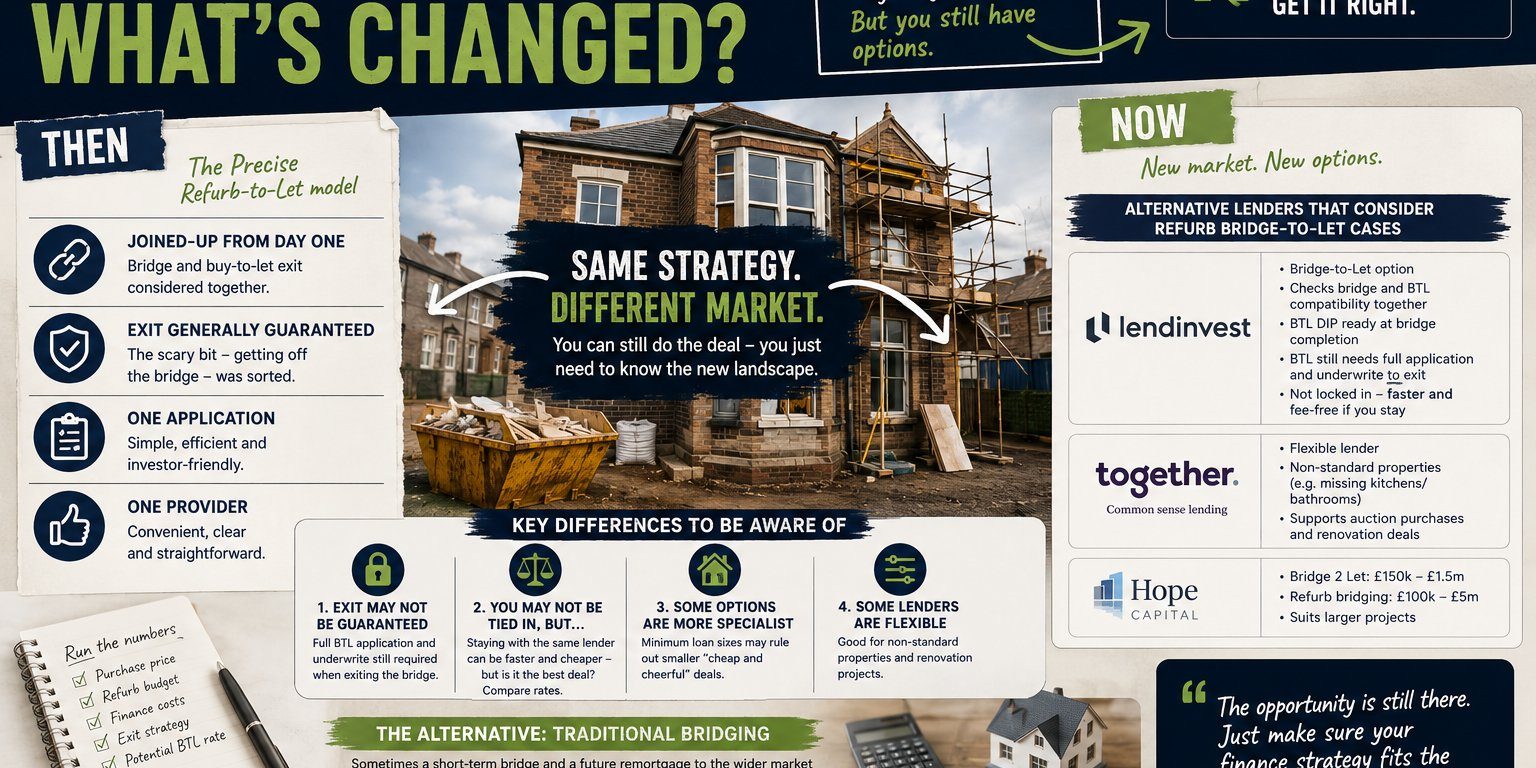
My very good mortgage broker tells me there are still lenders who will consider refurb bridge-to-let style cases, including names such as Together, Hope Capital and LendInvest.
That is the good news.
But, not being a broker, and having never used them, I don’t know anything about them. So I did a bit of digging and this is what I found.
The main differences with the old Precise Product are:
1. The exit may not be guaranteed
LendInvest’s Bridge-to-Let looks fairly joined-up. They say they check bridge and buy-to-let compatibility at the same time, and a buy-to-let DIP can be ready when the bridge completes. But they also say the buy-to-let still needs a full application and full underwrite when the investor is ready to exit the bridge. So, it’s helpful, but the exit isn’t quite “done and dusted and guaranteed from day one”. You’d need to work closely with your broker to make sure the property will be suitable for a buy to let when you finish the work.
2. You may not be tied in, but convenience may come at a cost
LendInvest also says investors are not locked into their buy-to-let product, but the process is faster and without fees if they stay with LendInvest for the exit. That’s useful flexibility, but it also means the investor still needs to compare whether staying with the linked lender is actually the best deal at the time, and whether it would still be worth refinancing to a different lender. Again, guidance from a mortgage broker is required.
3. Some options are more specialist, so they may not suit smaller “cheap and cheerful” deals
Hope Capital lists Bridge 2 Let from £150k to £1.5m, and refurbishment bridging from £100k to £5m. That may be fine for bigger projects, but it will rule out smaller-value properties or lower loan amounts.
4. Some lenders are flexible
Together is clearly flexible. They mention non-standard properties, including missing kitchens or bathrooms, and they also support auction purchases and renovation-style cases.
The Alternative: Traditional Bridging
In some cases, a traditional bridge may be the more sensible approach. That sounds slightly backwards, because most of us prefer certainty.
But if a joined-up bridge-to-let route leaves you tied to a high buy-to-let rate afterwards, it may be worth asking whether you are better using a short-term bridge, completing the works, and then refinancing into the wider market once the property is ready and you have owned it long enough for more lenders to consider the case.
The figures will need testing properly, and you need to be talking with your broker about the exit even before you buy the property.
As ever, this isn’t advice. Please make sure you speak to a good broker before buying or borrowing, and do your own due diligence.
If you don’t have a good broker, or if you’d like a second opinion, I’ll be happy to introduce you to my very good broker. Just email me at
and I’ll make the introduction.
Here’s to successful property renovating.

Peter Jones (ex) Chartered Surveyor, author and property investor
www.thepropertyteacher.co.uk
 By the way, I’ve completely rewritten and updated my course for 2026, The Successful Property Renovator’s Workshop – a comprehensive guide to renovating properties properly and profitably, based on my own experience across well over 150 projects over thirty years.
For more details please go to: https://thepropertyteacher.co.uk/the-successful-property-renovators-workshop/