


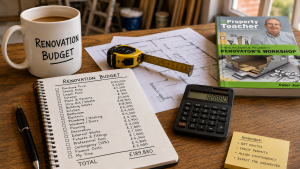
A renovation budget that does not include all the real costs is not really a budget at all.
It is a hopeful sketch.
That may sound a bit blunt, but it is the most accurate way I know of describing a lot of first-draft refurbishment budgets. The obvious items are there. Kitchen. Bathroom. Decoration. The rest is hazy, half-remembered, underestimated, or missing altogether.
And that is exactly how profit starts quietly leaking away.
The works themselves
The starting point is a full list of what the property actually needs.
Not just the headline items.
Everything.
Clearing out.
Strip-out.
Damp treatment if required.
Rewiring.
Heating.
Windows.
Roof work.
Making good.
Tiling.
Joinery.
Floor coverings.
External works if relevant.
This is one of the areas where people get lazy without meaning to. They remember the big-ticket pieces and assume the rest will sort itself out.
It doesn’t.
Use current local figures
Once you have the list, the next step is pricing it properly.
That means current local quotes, from people who actually work in your area.
Not memory.
Not national averages.
Not what somebody else paid in a different part of the country a year or two ago.
Current.
Local.
Real.
If you can get more than one quote for key trades, all the better. Not necessarily to chase the cheapest, but to understand the range and make a sensible decision about quality, reliability and value.
Labour deserves respect
Labour is one of the areas people most often underestimate.
Materials are easy to focus on because they are visible and easier to compare. Labour is more slippery. Different trades, different timescales, different levels of experience, and rising costs in busy markets.
But labour is a major part of the true budget.
If it is treated as an afterthought, the figures can move against you very quickly.
Your own time is not free
Another thing investors often fail to cost is their own time.
If you are project managing the job yourself, that takes time.
If you are doing admin, site visits, coordinating trades, solving problems and keeping the thing moving, that has a value.
And if you are also doing any physical work yourself, that time has a value too.
Not including it does not make it free.
It just means you are hiding part of the cost from yourself.
Finance costs matter more than people think
If you are borrowing, the interest needs to be included for the whole projected duration of the job.
Not just the purchase stage.
The whole thing.
And if the project drifts, which they often do, the cost drifts with it.
Even if you are using your own cash, there is still an opportunity cost. That money could have been doing something else.
So whether the charge is actual or notional, it still belongs in the appraisal.
Always include contingency
Always.
There will almost always be something.
Something hidden.
Something more extensive than expected.
Something that only becomes obvious once the work begins.
Ten percent is often used as a rough starting point, but it is not science. On some properties that may be plenty. On others it may not be enough at all.
The point is not the exact percentage.
The point is accepting that unexpected costs are normal, not exceptional.
What the finished budget is really for
A proper budget gives you the full number before you buy.
That is what matters.
Because that full number is what allows you to decide whether the project is viable, whether the margin is really there, and whether the deal still works if life behaves like real life rather than an optimistic spreadsheet.
If the profit only appears when every assumption is kind, then it is not much of a profit.
A realistic budget protects you.
Not from every problem, because there will still be problems. But from kidding yourself.
And that is one of the most useful protections an investor can have.
Here’s to successful property renovating.

Peter Jones (ex) Chartered Surveyor, author and property investor
www.thepropertyteacher.co.uk
 By the way, I’ve completely rewritten and updated my course for 2026, The Successful Property Renovator’s Workshop — a comprehensive guide to renovating properties properly and profitably, based on my own experience across well over 150 projects over thirty years.
For more details please go to: https://thepropertyteacher.co.uk/the-successful-property-renovators-workshop/